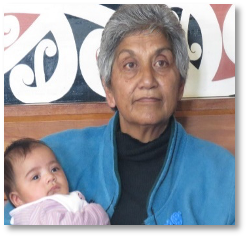
Peggy Luke Ngaheke is the Manager of the Kohanga Reo Trust of New Zealand that employs over 5000 women. She is also on the New Zealand Philanthropic Trust and Manager of the Waiwhetu Marae. Peggy spoke to us on the history of the Waiwhetu Marae. She derives from Maori parents but English grandparents.
In the 1900's Peggy's grandfather Ihaia Puketapu, travelled from Waitara to Wellington where the family settled in what was known as the Pipitea area. When the British arrived in New Zealand they pushed the people out to live in Petone and Seaview. The old Ford Factory in Seaview itself became the original Marae during the Second World War. Twenty six families maintained their farms, built their own water source and essentially became the farmers of the area.
Another move was to come when State Housing was introduced and the Government needed the land to house more families.
In 1953 as the outgoing Prime Minister, McLean gave way to the incoming Sir Walter Nash, Peggy"s Grandfather spent 4 days negotiating a deal that would see the twenty six families moving to a 100 acre block in and around Puketapu Grove Waiwhetu where they would settle finally.
What is known as Waiwhetu Marae now was built only after the houses had been completed. From start to finish all ethnicities were instrumental in completing the structure - there was no divide as to who would help. The men became the labourers and the women cared for the children and the home. Sadly persecution was rife between Pakeha and Maori, affecting the children mostly as they were chastised at school and beyond. Te Reo (the language) was not always heard as the people slowly began to lose their language alongside their heritage. It became the start of rebuilding all they believed in, and the Marae has subsequently become one of the most important and cherished Taonga (Treasures) this city has to offer.
The conception of the Kohanga Reo movement has lifted the educational system for Maori and now every child is totally fluent or bi-lingual. The Marae itself houses the Kohanga. It proudly boasts its own Medical Centre, Gym and the Atiawa Toa FM Radio station. It employs 17 staff, seven days a week and is open to tourism of every nationality.
Of most prominence is the Te Maori Centre opened by former Prime Minister Helen Clark across the road on Te Whiti Park. This is where the Runanga Services are held as well as two one ton carved Waka carved by master carver Rangi Hetet in 1990. One Waka was built for the Hutt city and the other for Wellington as our neighbouring town. Te Awa Kairangi Ki Tai (Lower Hutt) has always cared for its Waka but sadly this was not the case for Wellington. When it was discovered in a case of neglect and bad disrepair, the Waka was removed, restored and placed next to it's twin in Te Maori Centre.
Today the Marae is 65 years young. There are now third generation families living in Puketapu Grove. They believe they are there to serve the people. Covid became an example of just how many relied on the special brand of friendship the people of Waiwhetu Marae could offer. The Marae continues to learn and promote with special importance around young people, their health, and their sporting achievements.
At the heart of the Waiwhetu Marae is the beautifully carved and panelled Arohanui Ki te Tangata (peace to all Men) meeting house, named not for an ancestor but for a legacy and philosophy,